Sand Mine waterproof outdoor rugs are built from 100% virgin polypropylene with heat-treated edges — not because it sounds good on a product page, but because it's what actually survives season-after-season folding, direct sun, muddy dogs, and campsite gravel without fraying or fading. The line runs from a 3x5 ft (15 sq ft) tent-entry mat all the way to a 10x20 ft (200 sq ft) full campsite cover, with 18 options in between — including sizes like the 9x18 and 10x20 that most competitors at this price tier simply don't offer. Every rug ships with a carry bag and, on most larger sizes, 4 corner stakes, so there's nothing to buy separately before your setup is ready. Across the flagship 9x12 cluster alone, Sand Mine has accumulated 13,243 verified Amazon reviews at a 4.4-star average — one of the most validated outdoor rug lines on Amazon.
Sand Mine uses 100% virgin polypropylene — not recycled or blended filler — so the weave holds its color and structure through repeated folding and multiple outdoor seasons.
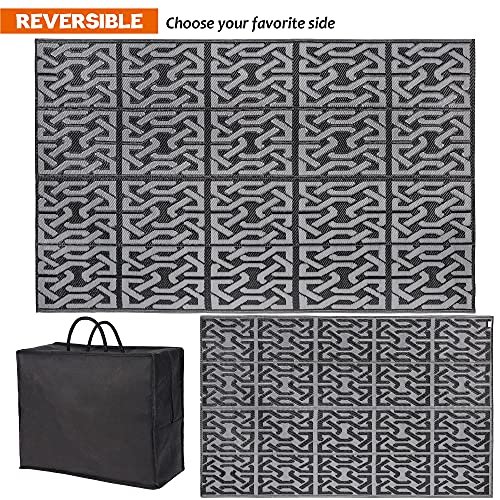
Every Sand Mine rug ships with two distinct finished faces — flip to the other side to distribute wear and extend the rug's useful life without buying a replacement.
Corner loops, 4 ground stakes, and a carry bag come in the box with most sizes — nothing extra to buy before you're set up on grass, gravel, or a campsite pad.
The lineup covers 15 sq ft to 200 sq ft, including the 9x18 and 10x20 RV awning sizes that most competitors at this price point don't make.
Sand Mine makes two overlapping series — the Classic/Core line in flat-woven and braided constructions, and the Waterproof/Lattice series with a wider colorway range and a few genuinely waterproof options (not just water-resistant). Water ratings across the line run three tiers: water repellent on the compact sizes, water resistant on most mid-range and large options, and waterproof on select lattice models. Cards below are sorted smallest to largest footprint, with the LED Edition last as a specialty item — scan down until you hit your size range, then compare colorway and construction options within that group.
The smallest footprint in the Sand Mine catalog at 3x5 ft (15 sq ft) — a flat-woven, water-repellent mat with a Black & Beige lattice pattern and carry bag included. Spot clean only. At 60 inches long by 36 inches wide, it's the right size for a tent vestibule, narrow balcony, or van-life entry point where a 4x6 would be too large to pack efficiently.
The only Sand Mine size that works as a true doormat-scale mat — best for van lifers, tent entry points, and narrow balcony owners who need the smallest possible polypropylene footprint.
See on Amazon
The 4x6 ft (24 sq ft) Lattice in Black & Beige — water resistant with a braided weave construction and reversible lattice pattern. Notably, the product name includes a -3% to 5% size variance disclosure, which is unusual transparency in the catalog and worth knowing if exact dimensions matter for your space. Carry bag included.
Best for small balconies, camping pads, and tent-entry setups where the 3x5 is just slightly too compact — the explicit size variance disclosure makes this the most dimensionally honest product in the line.
See on Amazon
Same 4x6 ft (24 sq ft) footprint as B09JWCD3J5, but in a Black & Brown colorway — the warmest tone at this size, with confirmed weight data of 1.61 lbs making it the lightest verified option in the compact range. Water repellent, hand wash only, stain resistant. Ranks #59 in Picnic Blankets on Amazon, which tells you buyers actually use this one as a portable ground cover.
The brown-and-black lattice is the warmest colorway at the 4x6 size — best for campers, picnic-goers, and portable-use buyers who prefer earthy tones over the cooler grey and black-and-beige options.
See on Amazon
The 5x8 ft (40 sq ft) Classic in Black & Grey — the single most-reviewed product in the entire Sand Mine catalog with 13,243 Amazon reviews at 4.4 stars. Braided weave, water resistant, hand wash only, UV stabilized, reversible. No ground stakes on this size. Covers a loveseat with coffee table or a compact balcony seating area.
If you want the most Amazon-validated Sand Mine option available, this is it — 13,243 reviews is a level of real-world feedback that most outdoor rugs never approach.
See on Amazon
The 5x8 ft (40 sq ft) option in Black & Beige — the beige reads as off-white to light tan in outdoor light, not a crisp white. This ASIN carries the strongest care language of any 5x8: washable, weatherproof, durable, reversible. Ranked #2 in Outdoor Rugs on Amazon, which makes it the most algorithmically prominent product in the catalog. Water resistant, braided construction.
Ranked #2 in Outdoor Rugs on Amazon — the best first purchase for a buyer who wants the highest-validated option at the 40-square-foot footprint, particularly if the Black & Beige colorway suits their space.
See on Amazon
The 6x9 ft (54 sq ft) Boho in Grey & White Style 1 — a braided construction with a 0.2-inch pile height and a lighter geometric palette that crosses over between outdoor and covered-porch use more naturally than the standard lattice options. Water resistant, indoor/outdoor designation. Stock is limited — check Amazon for current availability.
The lighter grey-and-white palette makes this the most apartment-balcony-friendly option in the 6x9 range — best for covered porches and semi-indoor spaces where a bold black-and-white lattice would read too stark.
See on Amazon
The 6x9 ft (54 sq ft) Boho Bohemia variant — same braided construction and 0.2-inch pile height as Style 1, but a distinct geometric pattern and the most indoor-forward room designation in the entire line: bedroom, living room, and office. Water resistant. Very limited stock at time of research. Best for mudroom, sunroom, or living-room-adjacent use where the rug genuinely moves between inside and outside.
The only Sand Mine rug explicitly listed for bedroom and living room use — if you need genuine indoor/outdoor crossover at the 6x9 footprint, this is the one to check first.
See on Amazon
The 6x9 ft (54 sq ft) Waterproof Lattice in Black & White — this is one of only two Sand Mine products with a genuine waterproof designation (not just water resistant), and the stain-resistant spec is confirmed. Flat woven, spot clean only, stakes and corner loops included. The black-and-white pattern is the highest contrast colorway at this footprint. Ranked #2 in Outdoor Rugs.
If you're in a high-rain climate or want genuine waterproof performance at the 6x9 size — not just water resistance — this is the correct choice, paired with the boldest lattice pattern in the 6x9 range.
See on Amazon
The 8x10 ft (80 sq ft) Classic in Black & Brown — the warmest colorway at this size, with confirmed weight data of 6.61 lbs. Braided construction, water resistant, spot clean only, stakes and corner loops included. Fills the gap between the 6x9 and 9x12: enough coverage for a mid-size sofa-and-chairs arrangement where 9x12 would overshoot and 6x9 would leave chair legs hanging off the edge.
The right size for a mid-size seating area that the 6x9 can't quite cover — the black-and-brown colorway is the only warm-toned option at 80 square feet.
See on Amazon
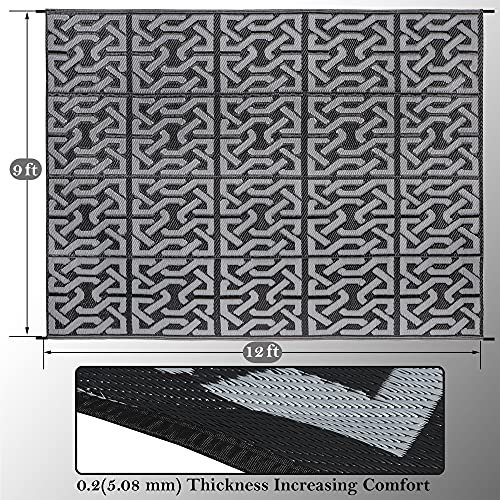
The flagship 9x12 ft (108 sq ft) Classic in Black & Grey — flat woven, water resistant, UV stabilized, with corner loops and 4 ground stakes included. At 108 sq ft, this is the standard recommendation for a dining table with 4–6 chairs: the rug extends far enough that chair legs stay on the surface even when someone pushes back from the table. Part of the 13,243-review cluster.
The go-to size for a full outdoor dining or seating area — 108 sq ft covers a 4-to-6-chair dining set with room for chairs to pull back without sliding off the edge.
See on Amazon
The 9x12 ft (108 sq ft) Basketweave variant in Black & Grey — distinguished from B089FJCRYC by its tufted construction rather than flat woven, and by an explicit indoor/outdoor designation. Weight is confirmed at 6.61 lbs. Stakes and corner loops included. The basketweave texture reads differently than the flat lattice, which matters if the flat pattern doesn't suit your furniture aesthetic.
Same 108 sq ft footprint as the flat-woven 9x12, but with a tufted basketweave texture and explicit indoor/outdoor use rating — the right pick if you want the 9x12 coverage with a different surface feel or crossover application.
See on Amazon
The 9x12 ft (108 sq ft) Lattice in Black & Grey — flat woven, water resistant (the product title says "Waterproof" but the tech spec confirms water resistant; worth noting if the distinction matters for your use case), with corner loops and 4 stakes included. The lattice pattern gives this a bolder geometric look than the flat-woven plain or basketweave 9x12 options. Ranked #2 in Outdoor Rugs.
The 9x12 option for buyers who specifically want a bold black-and-grey lattice pattern over a plain or basketweave finish — note that the water spec is water resistant, not waterproof, despite the product title.
See on Amazon
The only square-format rug in the Sand Mine catalog at 10x10 ft (100 sq ft) — braided, low pile, Black & Beige lattice with a non-slip grid backing. For most rectangular spaces a rectangle fits better, but square patios, gazebo floors, and fire-pit seating arrangements where coverage needs to spread equally in all directions are exactly where this format makes sense.
The only square option in the lineup — 100 sq ft that distributes evenly in all directions, best for gazebo pads, square patio footprints, or fire-pit seating circles.
See on Amazon
The 8x16 ft (128 sq ft) Lattice in Black & Beige — a wide-format option that sits between the 9x12 and 9x18 in coverage. Braided construction, low pile, non-slip grid backing, UV resistant coating. At 128 sq ft across a 16-foot length, this is the practical choice for travel trailer owners whose awning extends 14–16 feet — enough coverage without committing to the full 9x18 footprint.
Fills the gap between 9x12 and 9x18 — best for travel trailer awnings in the 14–16 ft extension range where the 9x12 comes up short and the 9x18 is more than needed.
See on Amazon
The 10x14 ft (140 sq ft) Lattice in Dark Blue & White — the only blue colorway in the entire Sand Mine catalog, and one of only two products in the line with a confirmed waterproof designation (stain resistant: Yes). Braided, low pile, spot clean only. At 140 sq ft, it covers a large seating area or mid-size RV awning extension while delivering an aesthetic that no other Sand Mine size offers.
The only blue option in the Sand Mine lineup, with genuine waterproof performance at 140 sq ft — if you're searching for a navy or coastal outdoor rug, this is the one to check first.
See on Amazon
The 9x18 ft (162 sq ft) flagship for RV buyers — flat woven, water repellent, with corner loops and 4 ground stakes included. The Brown & Black Basketweave is the warmest colorway available at this footprint. At 162 sq ft and 18 feet long, this covers a full standard awning extension for most Class A and Class C motorhomes — nothing else in the classic lineup comes close to this coverage in a single piece.
The RV awning anchor of the Sand Mine lineup — 162 sq ft covers most Class A and Class C motorhome awning extensions in a single rug, no splicing required.
See on Amazon
The largest rug in the Sand Mine catalog at 10x20 ft (200 sq ft) — braided polypropylene with a non-slip grid backing, UV resistant coating, and a Grey & Tan lattice colorway that's the only warm neutral available at this large format. At 200 sq ft, this exceeds the 9x18 by 38 sq ft and opens coverage for the largest motorhomes and full outdoor entertaining setups that the 9x18 can't fully reach.
At 200 sq ft, this is the largest Sand Mine option and the only one with a grey-tan colorway — best for the largest RV setups or full outdoor entertaining areas where the 9x18 still comes up short.
See on Amazon
The only rug in the Sand Mine catalog with built-in lighting — an 8x10 ft (80 sq ft) braided mat with an LED strip around the perimeter, housed in weatherproof PVC tubes. Powers via a direct power bank connection or a standard charger block plugged into a socket. Spot clean only — more restrictive than most other sizes. Water resistant. The striped Black & Beige pattern is distinct from the lattice and basketweave options throughout the rest of the line.
No other Sand Mine rug does this — the LED perimeter strip turns the 8x10 into ambient evening lighting for patio gatherings, powered by either a power bank or a wall socket.
See on AmazonThe Classic series covers four foundational sizes that handle most patio and RV scenarios — but the construction type, water rating, and what's included in the box differ across them in ways the product titles don't always make clear. Here's how the four most-referenced options stack up on the specs that actually determine the right fit.
| Feature | Classic 5x8 (Black & Grey) | Classic 9x12 (Black & Grey) | Classic 9x18 (Brown & Black) | Basketweave 9x12 (Black & Grey) |
|---|---|---|---|---|
| Size | 5x8 ft | 9x12 ft | 9x18 ft | 9x12 ft |
| Coverage | 40 sq ft | 108 sq ft | 162 sq ft | 108 sq ft |
| Weave type | Braided | Flat woven | Flat woven | Tufted |
| Water rating | Water resistant | Water resistant | Water repellent | Water resistant |
| Ground stakes included | No | Yes — 4 stakes | Yes — 4 stakes | Yes — 4 stakes |
| Carry bag included | Yes | Yes | Yes | Yes |
| Care method | Hand wash only | Rinse with water | Rinse with water | Rinse with water |
| Indoor/outdoor rating | Outdoor | Outdoor | Outdoor | Both |
| Confirmed weight | Not listed | Not listed | Not listed | 6.61 lbs |
For a loveseat-and-coffee-table setup, the 5x8 is the right call — but note it doesn't include stakes and is hand wash only, so it's less suited to campsite use than the larger sizes. The 9x12 flat-woven and the 9x12 basketweave cover identical square footage, so the decision there comes down to texture preference and whether you need the explicit indoor crossover rating the basketweave carries. The 9x18 is strictly for RV awning coverage — at 162 sq ft it's a different product category than the patio sizes, and the water repellent rating (one tier below water resistant) is worth knowing before committing.
The most common Sand Mine purchase mistake isn't buying the wrong pattern — it's buying the wrong size. Most buyers underestimate how much coverage they actually need once furniture is in place. Here's how to match your situation to the right option before you order.
If you're setting up under a motorhome awning, size is the only variable that matters at the start. The 9x18 ft (162 sq ft) covers a full standard awning extension for most Class A and Class C motorhomes. For larger Class A coaches — particularly those 38 feet or longer with awning arms that extend further than the slide — the 10x20 ft (200 sq ft) is the correct choice. Don't guess: measure along your coach with the awning extended before ordering.
Travel trailer owners typically land in a different range. A trailer with a 14–16 ft awning extension fits well under the 8x16 (128 sq ft) — that's where the unusual dimension earns its place in the lineup. The 9x12 works for smaller travel trailers and pop-ups where the awning extends 10–12 feet along the coach side.
For all RV and camping use, push the included stakes in at an angle against the prevailing wind direction — not straight down. Gravel and firm grass respond well to this method. Loose sand is another story; on sandy sites, weight the corners with gear bags instead.
A dining table with 4–6 chairs needs the 9x12 (108 sq ft) at minimum. The specific reason: chairs that get pulled back from the table need to stay on the rug surface so legs don't catch the edge and flip the rug corner. The 9x12 gives you roughly 18 inches of rug beyond the table perimeter on each side, which handles that movement without the rug shifting. A 6x9 technically fits 4 chairs when they're tucked in — but the first time someone stands up, a chair leg lands off the edge. That's the mistake reviewers make most.
For a very large dining set — 8-person table, extended sectional — look at the 10x14 (140 sq ft) or the 10x10 (100 sq ft) if your patio footprint is roughly square. The 10x10 is the only square format in the line, and it distributes coverage evenly in all directions, which matters for round fire-pit seating or a gazebo with equal-length sides.
A standard loveseat with a coffee table fits on the 5x8 (40 sq ft) with room to spare on the short ends. If you add two chairs on either side of the coffee table, go up to the 6x9 (54 sq ft). A full sofa plus two chairs needs the 8x10 (80 sq ft) or the 9x12 depending on how deep your chairs are.
On wood or composite decking, the included ground stakes don't apply — they're for grass and gravel. On a deck, weight the rug corners with furniture legs. If your deck surface is smooth and the rug slides, a strip of outdoor rug tape on the underside corners costs a few dollars and solves the problem completely. This is the most common complaint from deck users, and it has nothing to do with the rug — it's a physics issue on any smooth surface.
One sizing note that applies to every deck arrangement: always measure your actual furniture footprint with pieces in their normal positions before checking sizes. The rug should extend at least 12–18 inches beyond the outer legs of the largest piece on each side. If you're between sizes, go up. A rug that's slightly too large can be trimmed at the edges — the heat-treated construction holds — but a rug that's too small will look wrong from the first day.
For tent camping and van-life setups, the priority is packability over coverage. The 4x6 (24 sq ft) folds down small enough for most storage compartments and at 1.61 lbs — the confirmed weight of the Black & Brown variant — it barely registers in a load. The 3x5 (15 sq ft) goes even smaller, though at 60 inches by 36 inches it's genuinely doormat-scale: enough to keep dirt off a tent vestibule floor, not enough to set up camp chairs on.
Most campers who want to actually sit outdoors on the rug land on the 5x8 (40 sq ft) as the portable sweet spot — big enough for two chairs and a cooler, small enough to fold into the carry bag and toss in a truck bed. The 9x12 is doable for car camping with a full SUV or truck, but it takes real effort to fold neatly enough to fit back in the bag. Campers in r/Camper have noted this specifically: "folds up easily into about a 3-foot by 1-foot bag" is the experience with the smaller sizes, not the 9x12.
The Boho 6x9 options — particularly the Bohemia variant — are worth considering for covered-porch camping setups or glamping where the lighter grey-and-white palette suits the aesthetic better than the standard black-and-grey. The 0.2-inch pile height gives a slightly softer underfoot feel than the flat-woven sizes, which some campers prefer for sitting directly on the ground.
RV and camping buyers ask different questions than patio buyers, and they have specific frustrations with outdoor mats that most content doesn't address directly. Mold underneath, edges that unravel after five fold-and-pack cycles, colors that fade to nothing by the third season — those are the real problems. Here's what Sand Mine does and doesn't solve for that use case.
The 9x18 ft (162 sq ft) handles most Class A and Class C motorhome awning extensions. At 18 feet long and 9 feet wide, it covers the full width of the awning drop zone — including the few feet of rug that extend past the slide. For a standard 36–40 ft Class A with a typical 21-ft awning, the 9x18 covers the primary living area underneath without fully reaching the tow vehicle end.
The 10x20 ft (200 sq ft) is a different scenario. At 200 square feet — 240 inches by 120 inches — it's genuinely the largest polypropylene mat at this price tier. Full-timing couples who set up a complete outdoor kitchen, two chairs, and a dining area under the awning in one continuous spread have used the 10x20 specifically because the 9x18 left the kitchen area on bare ground. The Grey & Tan colorway also reads warmer than the standard black-and-grey options, which some RVers prefer against tan or white coach exteriors.
Honest limitation: both sizes are flat-woven polypropylene, not cushioned outdoor flooring. Barefoot is comfortable. Standing for an extended cooking session on a hard gravel pad — less so. This is worth knowing before you replace a dedicated foam mat with a Sand Mine rug expecting the same underfoot feel.
The included 4-stake system works, but angle matters. Most buyers push stakes straight down and then wonder why the rug lifts on a windy afternoon. The correct method: angle each stake inward at roughly 45 degrees, leaning toward the center of the rug, and push firmly until the loop sits flush against the surface. On compacted gravel, this locks the corner against wind lift considerably better than vertical stakes.
On grass, the stakes go in easily but the holding power depends on how dry the ground is. Wet grass — especially after overnight rain — loosens stake grip. If you're at a campsite and weather is uncertain, add a second stake through each corner loop crossed at a different angle. Takes 30 seconds and the difference is significant.
On concrete pads at RV parks, skip the stakes entirely. The non-slip grid backing on the 10x20, 8x16, and 10x14 models provides some friction on hard surfaces, but not enough to hold in sustained wind without furniture weight on the corners. Set up chairs and your gear bags on the rug edges before you run the awning out.
The 9x12 folds down reasonably well with two people — fold in thirds lengthwise, then in thirds crosswise, and it fits back in the carry bag without a fight. The 9x18 is a different exercise. At 162 sq ft of polypropylene, it takes two people and a deliberate fold sequence: fold in half lengthwise first, then in thirds, then roll rather than fold the final pass. Rolling instead of folding for the last step keeps the bulk manageable and reduces the crease lines you'll need to flatten at the next site.
The 10x20 is a team effort. Plan for 10–15 minutes to pack it properly at departure. This isn't a complaint specific to Sand Mine — it's the reality of 200 sq ft of any flexible material. The carry bag handles it once you get there, but don't expect the 10x20 to drop into the bag as easily as the 5x8 does.
The core reason Sand Mine rugs work at campsites is that polypropylene doesn't absorb water. Mud lands on the surface, dries, and sweeps off. Rain drains through the open weave rather than pooling and soaking through to the ground. Mold needs moisture — and a rug that doesn't hold moisture doesn't give mold a foothold. Multiple reviewers across four-plus years of outdoor use have confirmed this property holds over time, not just out of the box.
The breathable construction also matters for grass campsites. Because air moves through the weave, the grass underneath doesn't get sealed off from oxygen and moisture the way it would under a solid tarp or rubber mat. The rug can stay down for a week without killing the grass underneath. Leave it longer than that and you'll get yellowing — but for a typical camping stay, it's a non-issue.
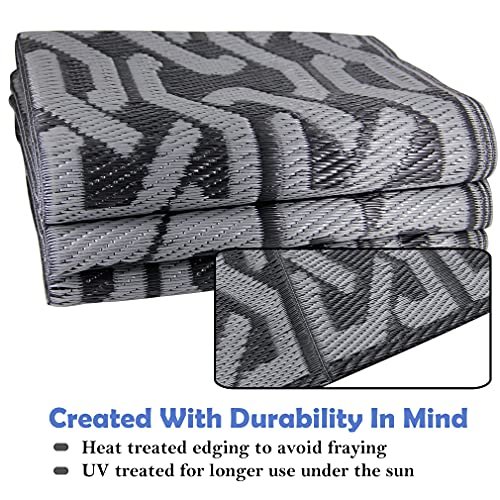
Heat-treated edges are the other campsite-specific advantage. Every fold and pack cycle puts stress on the perimeter. A stitched or glued edge eventually unravels under that repetition. The heat-treated construction fuses the edge rather than binding it, which is why reviewers who've used the same Sand Mine mat for 3–4 seasons report no fraying — even on the compact sizes that get folded most aggressively.
More Sand Mine rugs get returned because of size errors than any other reason. The fix is simple: anchor every size to a specific furniture footprint before you buy. Here's how the lineup maps to real setups, with the chair-pull-back rule that most size guides skip.
This is the rule that changes most buying decisions. Chairs that stay tucked under a table can share a smaller rug. Chairs that get pulled back when someone sits down — which is every normal dining chair — need the rug to extend far enough that the back legs don't slip off the edge. The safe margin is at least 18 inches of rug beyond the table edge on the sides where chairs pull back. For most 4-person dining sets, that means the 9x12 (108 sq ft) is the minimum, not the 6x9.
Apartment balconies are the situation where buyers most consistently buy too small. A 6-foot-wide balcony with a two-person bistro set needs a 5x8 at minimum — the 4x6 leaves the chair legs hanging off the back edge. Measure your balcony floor first, then subtract 6 inches from each dimension to get the maximum rug size that won't curl up against the railing or wall. That number usually lands you in the 5x8 or 6x9 range for a standard apartment balcony.
The Boho 6x9 options are worth a specific mention for balcony buyers: the grey-and-white palette reads more interior-friendly than the standard black-and-grey lattice, which matters when your balcony is visible from inside through a glass door. The Bohemia pattern specifically is listed for bedroom and living room use — making it the most crossover-appropriate option in the line for buyers who want the rug to read as part of the interior when the door is open.
A rug that's slightly too large for a space can be trimmed at the edges — the heat-treated construction holds at a cut edge. A rug that's too small looks wrong immediately and can't be fixed without buying another one. If you're genuinely between two sizes and can't measure precisely, order the larger size. The return rate for "too large" is a fraction of the return rate for "too small."
A Sand Mine rug won't arrive looking the way it does in the product photos — at least not immediately. There are a few things that are consistent across the line that are worth knowing before you open the box, so none of them come as a surprise.
Every Sand Mine rug ships folded, which means it arrives with fold creases. This is normal and consistent across all 18 options — it's not a defect, and it doesn't mean the rug is damaged. The creases flatten out on their own; the question is just how long it takes.
Smaller sizes (3x5, 4x6, 5x8) typically flatten within 24–48 hours when laid on a flat surface with furniture weight on the corners. The 9x12 and larger sizes take longer — plan for 2–3 days of furniture weight on the edges, or one afternoon of direct sun exposure. Polypropylene relaxes with heat, so summer temperatures do the work faster than a shaded interior. If you're in a hurry, lay the rug flat on a sunny deck for a few hours before bringing furniture onto it.
Don't expect the 9x18 or 10x20 to flatten in a day. At that footprint, the fold memory takes time to release. A week of normal use and foot traffic gets most of it — any remaining ridges at the fold lines usually disappear by the second week.
Polypropylene flatweave is lightweight by design — that's what makes it packable and portable. The trade-off is that it moves in wind, and how much it moves depends entirely on your surface type.
On grass or compacted gravel, the included stakes handle wind well when pushed in at the correct angle (inward at 45 degrees, not straight down). Most buyers who report stake failure are pushing them vertically into loose soil or dry sand, where there's nothing for the stake head to catch against.
On wood decking, composite, or concrete, the stakes don't apply at all. The single most common complaint from deck owners — "the rug blows around" — has a simple fix: furniture legs on the corners. A chair leg on each corner of a 9x12 holds it in place through a 20-mph gust. For smooth deck surfaces where the rug slides rather than lifts, two strips of outdoor rug tape on the underside corners solve both problems.
The 10x20, 8x16, and 10x14 have a non-slip grid backing that improves grip on hard surfaces. The Classic series doesn't — worth knowing if you're choosing between otherwise equivalent options for a deck setup.
Sand Mine's own product listings include a note: "Colors show different in pictures due to lighting." That's not a legal hedge — it's genuinely accurate and worth taking seriously.
The "beige" in the Black & Beige colorway reads as off-white to light tan in most outdoor settings. It's not a crisp bright white and it's not a warm honey beige — it sits between those two, closer to an aged linen tone. In direct afternoon sun it reads lighter; in shade it reads slightly warmer. Buyers who expect a sharp white-and-black contrast based on product thumbnails sometimes find the outdoor reading more muted than expected.
The "grey" in the Black & Grey classic options is a balanced neutral — neither warm nor cool — and it reads more similarly in outdoor light than the beige tones do. The Brown & Black Basketweave on the 9x18 reads as a dark espresso brown against black, not a mid-tone caramel — it photographs lighter than it appears in person on overcast days.
The Dark Blue & White on the 10x14 is the most color-accurate of the catalog in product photos — navy blue reads as navy regardless of lighting condition. If colorway accuracy is critical, that's the most predictable option in the lineup.
This is not one-size-fits-all across the catalog, and mixing up the care instructions is how buyers damage a rug they otherwise would have kept for years.
The general rule of thumb: the larger flat-woven sizes tolerate full water rinsing; the smaller and specialty options are more restricted. When in doubt, check the specific ASIN's tech spec before hosing down — the product title says "waterproof" on some options where the care instruction is actually spot clean only.
Honest answer: a flatweave polypropylene rug is not plush underfoot. Standing barefoot on a Sand Mine rug on a concrete pad is comfortable for a few minutes; standing there for an hour of grilling is not. The material is firm, not cushioned. Buyers who want a soft outdoor surface should look at foam interlocking tiles or a thicker pile rug. Sand Mine is the right choice for durability, weather resistance, and low maintenance — not for softness.
It's also not a non-slip mat on smooth hard floors. On outdoor tile or polished concrete, the rug will shift underfoot without a rug pad or tape. On textured concrete or composite decking with a wood-grain surface, the grip is noticeably better. The non-slip grid backing on the newer models (10x20, 8x16, 10x14, 10x10) improves this, but none of them perform like a rubber-backed bath mat on a wet tile floor.
We picked this walkthrough from Wilderness Times because it covers the details that actually matter before you buy — material quality, edge construction, and how the reversible design works in a real outdoor setting. You'll see the virgin polypropylene flatweave up close and get a straight read on whether the heat-treated edges hold through repeated folding and packing. The breathable construction gets attention too, which matters if you're laying this on living grass and don't want a dead patch where your mat sat all summer.
"I've had the 9x12 Black and Grey on my back deck for going on three summers now. Colors are still recognizable — not as sharp as day one, but nothing like the faded-out rugs I'd bought before. The edges haven't frayed at all, which was my biggest concern after ruining two other rugs within a season. I wish it gripped the composite decking a little better, but furniture legs on the corners have solved that well enough."— Debra M., homeowner upgrading a deck seating area
"We bought the 9x18 for our Class A last spring and it covers the full awning extension with maybe a foot to spare on one end. Packs back into the bag without a total fight if two of us fold it together. Left it out through two rainstorms and a hailstorm — no mold, no warping, no permanent waterlines. The staking instructions could be clearer out of the box, but once you figure out the angle, it holds through wind."— Ron T., full-time RVer
"Ordered the 5x8 Black and Beige for my apartment balcony and the color in person is more of an off-white cream than the bright contrast in the photos. Still looks good, just not as stark. The rug itself flattened out within three days of sitting under my bistro chairs. Easy to shake out and it dries fast after rain — exactly what I needed for a balcony that gets afternoon sun and occasional downpours."— Jess P., apartment renter setting up a balcony
"We host a lot — Memorial Day through Labor Day, the back patio is in constant use. The 9x12 holds up to muddy shoes, spilled drinks, kids running through with water balloons. A quick sweep with a broom handles most of it. We flip to the other side halfway through the season and it genuinely looks fresh again. One minor issue: it takes a couple of weeks to fully stop creasing after you unbox it."— Marcus H., regular backyard entertainer
"I've been using the 4x6 Black and Brown for camping — car camping mostly, some festival use. At under two pounds it's nothing to pack, and the carry bag actually fits it back neatly. The brown-and-black pattern doesn't show dirt between cleanings, which matters when you're at a site for three days without water access. Hand wash only is fine for this size; I just rinse it at the campsite faucet and hang it to dry on the awning bar."— Alicia K., weekend car camper
"Bought the 5x8 Black and Grey three years ago based on the review count — figured 13,000 reviews meant people had actually tested it. Still have it. The rug has been rained on, snowed on in a late October storm, and dragged across a gravel driveway. The edges are intact. Colors are faded on one face from direct Texas sun, but I flipped it two summers ago and the other side still looks decent. Not soft underfoot on concrete, but that wasn't why I bought it."— David R., suburban homeowner replacing a worn-out patio rug
Polypropylene is the most practical material for outdoor patio use because it doesn't absorb water — moisture sits on the surface rather than soaking into the weave, which means faster drying and no mold growth underneath. Sand Mine's flatweave polypropylene construction specifically allows rain to drain through rather than pool, and the UV stabilization protects color through a full summer of direct sun exposure. For most patio setups, the 9x12 (108 sq ft) is the right starting size for a full dining or seating arrangement.
Polypropylene rugs handle rain, UV exposure, and temperature swings better than natural fiber options, but long-term outdoor storage through harsh winters shortens any rug's useful life. Sand Mine's UV coating resists color degradation through a full outdoor season. In regions with freezing temperatures or heavy snow accumulation, rolling the rug into the carry bag and storing it indoors from November through March is the practical call — that's what extends a 2-season rug into a 4-season one. The 9x18 and 10x20 should definitely come in for winter; the compact sizes handle light frost reasonably well.
For genuine waterproof performance — not just water resistance — the Sand Mine Waterproof 6x9 Lattice (Black & White, ASIN B0BX3QR5ZX) and the Waterproof 10x14 (Dark Blue & White, ASIN B0FVF8NMF3) carry confirmed waterproof designations with stain-resistant specs. Most other Sand Mine options are water resistant, which means they repel surface moisture but aren't rated for sustained submersion. The 3x5, 4x6 Black & Brown, and 9x18 carry the lowest-tier water-repellent rating. Match your climate's rainfall intensity to the correct water rating — if you get sustained heavy rain, start with a waterproof-designated model.
Natural fiber rugs — jute, sisal, cotton — absorb moisture and create conditions where mold grows readily underneath, particularly on grass or damp concrete. Polypropylene rugs like Sand Mine don't absorb water, so the mold equation changes: without moisture retention in the weave, there's no sustained damp environment for mold to establish. The breathable flatweave construction also allows airflow under the rug, which keeps the ground surface from staying sealed and wet. Lift and rinse the rug periodically if it's sitting on grass — once a week in wet climates — to clear any moisture buildup on the ground surface itself.
Virgin polypropylene is the most durable synthetic fiber for outdoor use at a practical price point — more resistant to UV breakdown and moisture damage than polyester, and significantly more weather-tolerant than natural fibers. Sand Mine specifically uses 100% virgin polypropylene rather than recycled or blended material, which matters for color retention and weave stability over multiple seasons. The heat-treated edges prevent fraying through repeated folding cycles — the failure point on most outdoor rugs at this tier is edge deterioration, not face wear. A YouTube reviewer documented a Sand Mine 5x8 holding up through 4 years of outdoor use with edges still intact.
The included ground stakes don't work on concrete — they're designed for grass and gravel. On concrete patios, the most effective approach is furniture leg weight on all four corners, which holds the rug in place through normal wind without any additional hardware. For smooth concrete where the rug slides underfoot, adhesive outdoor rug tape applied to the underside corners adds grip without damaging the surface. The newer Sand Mine lattice models (10x20, 8x16, 10x14, 10x10) include a non-slip grid backing that improves hold on hard surfaces compared to the Classic series, which has a plain plastic back.
Yes, with one honest qualification: a flatweave polypropylene rug isn't the right choice for everyone. If you want softness underfoot — something that feels like an indoor area rug — a Sand Mine mat won't deliver that. The material is firm, practical, and weather-tolerant, not cushioned. But for defining a patio space, protecting a deck surface, anchoring outdoor furniture visually, and surviving seasons of rain and sun without becoming a maintenance project, an outdoor polypropylene rug is genuinely useful. Sand Mine's 4.4-star average across 13,243 reviews on the flagship cluster reflects buyers who had realistic expectations and got what they came for.
Sand Mine uses three distinct water ratings across the 18-option catalog: water repellent (surface-level moisture deflection, used on the 3x5 and some 4x6 sizes), water resistant (the most common rating, used on most mid-range options including the 5x8 and 9x12 Classic), and waterproof (the strongest rating, confirmed only on the 6x9 Black & White Lattice and the 10x14 Dark Blue & White). Water resistant means the rug repels normal rainfall and surface splashes; waterproof means no absorption under sustained wet conditions. Note that the product title for the 9x12 Lattice (ASIN B08NSMGSLV) says "Waterproof" but the tech spec confirms water resistant — the spec is the accurate source.
Sand Mine rugs arrive folded and will have visible fold creases — this is normal for all 18 sizes. Smaller options (3x5 through 5x8) typically flatten within 24–48 hours under furniture weight. The 9x12 and larger sizes generally need 2–3 days of furniture-weighted corners, or one afternoon of direct sun exposure. Polypropylene responds to heat: a sunny afternoon on a summer deck relaxes the fold memory faster than interior storage. Don't roll the rug tightly right after unboxing — lay it flat and let the corners relax before setting furniture in place.
The 9x18 ft (162 sq ft) covers a full standard awning extension for most Class A and Class C motorhomes. The 10x20 ft (200 sq ft) is the correct choice for larger Class A coaches with extended awning arms or for setups where the living area extends beyond the standard awning footprint. For travel trailers with 14–16 ft awning extensions, the 8x16 (128 sq ft) is often a better fit than the 9x18. Measure your awning extension length before ordering — that single measurement determines whether you need the 8x16, 9x18, or 10x20.
I grew up camping in East Tennessee, where my dad's rule was simple: a decent mat at the RV door keeps the floor clean for the whole trip. No mat, and you spend the last morning vacuuming gravel out of the carpet before checkout. That stuck with me. When I moved into outdoor home retail in my twenties, I watched the same buying mistake repeat itself constantly — customers picking an outdoor rug based on how it looked in a product photo, not how it was built, and coming back six months later with a frayed edge or a patch of mold underneath that had killed the grass. The return conversation was always the same: "I didn't know it would do that."
That's what brought me to the Sand Mine product line. Not because polypropylene rugs are glamorous — they're not — but because the construction decisions that go into them actually matter for how long they last and how little maintenance they require. Virgin polypropylene versus recycled blends. Heat-treated edges versus stitched ones. A size range that goes to 10x20 ft rather than stopping at 9x12 like most competitors at this price tier. Those are choices that show up in whether a rug is still in usable condition after four seasons of sun, rain, folding, and campsite gravel. I've spent real time with this product line — on my own deck in Austin, at campsites in central Texas that get zero shade and triple-digit summer heat, and on gravel pads where the stakes either hold or they don't. I write about it the same way I'd explain it to a neighbor asking which size to order before they set up their new patio furniture.
The goal of this site is straightforward: help you get the size right the first time, understand what the water ratings actually mean across the 18 options, and set accurate expectations for what a flatweave polypropylene rug does and doesn't do underfoot. If Sand Mine isn't the right fit for your situation, I'll say so. But for most outdoor patio, deck, and RV awning applications, it's a well-built product at a price point that makes sense — and 13,243 Amazon reviews at 4.4 stars is a harder signal to argue with than any single opinion, including mine.
Here's the sentence for the Useful Guides section: Most outdoor rug questions come down to size, material, or whether it survives your climate — we've answered the ones we hear most.
Sand Mine sells exclusively through Amazon, with all 18 rug options available through the official SAND MINE store on Amazon.com. The brand's primary web presence at sandminerugs.com redirects to the Amazon store, which is where all current product availability, colorway options, and size selections are maintained. There is no separate direct-to-consumer storefront.
For questions about a specific order — shipping status, item condition on arrival, or returns — Amazon's standard customer service handles all Sand Mine purchases. Contact support through your Amazon account under "Your Orders." For product questions before buying, the Q&A section on each Amazon product page has answers from verified buyers across most size and colorway combinations.
All Sand Mine orders are fulfilled through Amazon, which means standard Amazon shipping timelines and return policies apply. Returns are processed through the standard Amazon return process within the applicable return window. No separate manufacturer warranty documentation was found in research — return and replacement support runs entirely through Amazon's system.